






Sustainability
Life Mystic
Methanol for Yachting Sustainable Energy Transition Applied to Internal Combustion
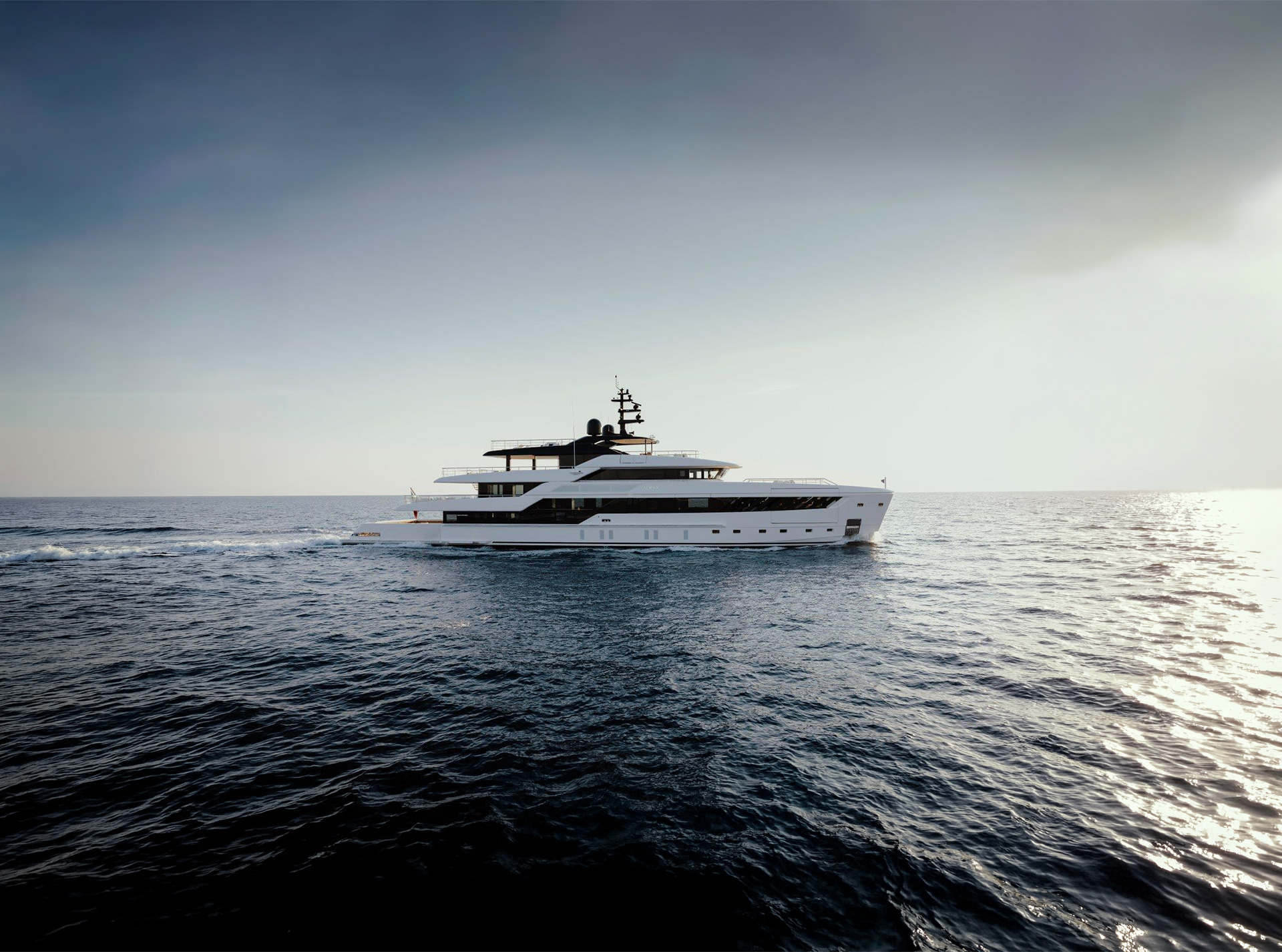
The purpose of the Life Mystic Project is to test engines and generators for Sanlorenzo superyachts powered by a combination of diesel and methanol instead of 100% diesel fuel.
The Member States of the International Maritime Organization (IMO), during the Marine Environment Protection Committee meeting (MEPC 80) in July 2023, agreed to adopt the IMO 2023 Greenhouse Gas Reduction Strategy for ships, which sets the goal of achieving carbon neutrality by 2050 instead of 2100, as previously established.
Sanlorenzo’s decarbonization strategy, however, aims to reach this target almost 10 years in advance, in line with the European Union’s “Fit for 55” strategy under the Green Deal, whose objective is to reduce emissions by 55% by 2030.
Maritime transport plays a very important role in terms of greenhouse gas emissions, as 90% of global trade takes place by sea. Around 100,000 vessels operate worldwide, and more than 300 megatonnes of diesel fuel are consumed each year.
To reduce emissions from maritime transport and comply with IMO regulations, several technologies are being explored, such as engine upgrades with after-treatment systems and the use of low- or zero-carbon fuels. Methanol (MeOH) is one of the most promising alternatives for the future of maritime transport. It is liquid at ambient temperature and is already available in more than 100 ports worldwide. When produced from renewable energy sources, methanol becomes a zero-emission fuel, as required by the net-zero strategy.
The accessibility of this substance is a key factor for the Life Mystic Project, as a vessel that cannot refuel in major locations would not be well received on the market. The availability of renewable methanol is therefore required by the Project to demonstrate that this solution would enable significant reductions in CO₂ and other pollutants.
According to statistics published by the Methanol Institute , a large number of production facilities are under construction, and many others are in the planning stage. Renewable methanol production (bio + e-methanol) in 2024 is expected to reach around 0.8 megatonnes, representing a 60% increase compared to 2023, while in 2025 it is projected to increase eightfold thanks to new production plants.
The use of methanol for the propulsion of low-speed two-stroke engines on large vessels, such as cargo ships, has already been tested, while its application in low-speed four-stroke engines is currently under review by engine manufacturers such as MAN and Wartsila for other maritime applications (not yet tested on yachts and superyachts). For this Project, a Sanlorenzo superyacht has been selected, where two high-speed four-stroke MAN diesel engines, in collaboration with Ranieri Tonissi as development partners, and two four-stroke diesel generators manufactured by Nanni Industries will be adapted to operate on board in a dual-fuel configuration.
The development of dual-fuel conversion kits involves a highly careful engineering process to ensure efficiency and reliability in the combustion of two different types of fuel within a single engine. It must guarantee a safe switch back to diesel-only operation at any time, making these engines an ideal solution for a transitional market.
The design takes the following aspects into account:
- the methanol fuel supply system to the engine;
- the methanol injection system, designed to precisely control delivery into each cylinder’s intake ports according to the correct timing and quantity;
- the modification of existing diesel injectors to accommodate the additional fuel;
- the ignition system: diesel/methanol engines will use compression ignition of both fuels (diesel and methanol respectively), where diesel acts as a pilot fuel.
Technical testing will ensure reliability and efficiency in the development of the prototypes to be installed on board.
The adaptation of the vessel’s design will be carried out by Sanlorenzo, which will be responsible for converting the two traditional diesel fuel tanks into methanol tanks, and for integrating the distribution system with the additional piping and instrumentation, completing the vessel’s full conversion to a dual-fuel configuration.
Reference: LIFE23-ENV-IT-LIFE MYSTIC/ 101148420
Acronym: LIFE23-ENV-IT-LIFE MYSTIC
Total Costs: 4.817.889,00
Total EU Contribution: 2.890.733,40
The results of the Project will be:
Funded by the European Union. The views expressed are, however, those of the author(s) only and do not necessarily reflect those of the European Union or the European Education and Culture Executive Agency (EACEA). Neither the European Union nor the EACEA can be held responsible for them.

RELATED
See also


